Showing posts with label Appraisal Physical Learning Spaces. Show all posts

Monday, 14 November 2016

The End of Year looms!

My 3 Great Steps:
1   Seek transformative feedback (not just information) that requires action to grow leadership.
How? Ask specific questions, engage in professional conversations.
2   Prioritise and balance responsibilities.
How? Book in social time and exercise, cull to-do lists weekly, ask myself if my contributions are 'token' or if I can commit fully.
3   Activate my professional reading
How? Write about it, record my synthesis, record my what now, and talk about it.

My biggest reflection on the year is that my goals were not great. They were mostly unmeasurable and non of them had a teaching focus - which meant that my teaching practice has not developed in the capacity that it could have.

My biggest achievement this year, has been what I've learned about myself and the way I deal with stress. Goal number two played a massive role here and creating time for myself has meant that I can read my own cues better to when I need to activate systems to deal with happenings.

There's been lots of highlights - being a part of the Innovation Incubator team, and the leadership that came with that, has been great. The team make-up was fabulous - serious enough but we had loads of fun, the topic was a passion of mine, and there has been so much learning! I've enjoyed taking a role in leading our team in some development around feedback and capacities also. And my team have been brilliant! I couldn't have asked for better people to work with.

Looking into next year I really want to bring my focus back to the classroom and the habitat. The leadership stuff will happen, now that I have got myself into it. I want to ensure that I'm modelling and promoting school-wide practices like capacities and learning conversations, which can run through progress pebbles.


Big goal: Progress pebbles
  1. Use of capacities to drive reflection/evaluation of progress
  2. Learning conversations/conferences/parent involvement
  3. Instructional techniques to achieve pebbles

Saturday, 9 April 2016

Am I moving towards my Desired Reality???

It's been a few weeks now since we set goals to reach our Desired Reality and it's time to check in on them. 


My 3 Great Steps:

1   Seek Feedback - constructive 70%/ positive 30%
The purpose of having this goal is to grow my capability as a leader. I have been getting some feedback, mostly in relation to co-leading the Innovation Incubator team, but I'm not really seeking feedback as the goal states. This one needs to become priority in Term 2. I have purchased a book called Thanks for the Feedback and I'm hoping I will dig into this over the holidays and get some inspiration. 

2   Honest conversations regarding priorities and balancing responsibilities
I have been persistent with some things and making my feeling known in habitat team meetings, sometimes without a result. Am I not being heard? Or is it that my priority is not a team priority? Hard to say - but working on my first great step could help with this. I am improving on saying no to things. In fact I can think of two examples where I have turned down 'extra' jobs because the timing and commitment wasn't right for me. 

I have found this term particularly busy. Before school was preparation time, non-duty lunchtimes and after school were basically meeting times. I have found it extremely difficult to find time to work with Emma on Innovation Incubator stuff, so it is essential that I continue to prioritise this goal.

3   Make time for professional reading (learning environment goal and Innovation Incubator)
At the beginning of the year I set myself a wee target of four professional development books over the year. I have already exceeded this! I have read 1) The Element 2) chapters from The Professional Practice of Teaching in NZ 3) Expansive Education 4) Show and Tell and I'm currently making my way through What's the Point of School


My One Line Job Description:
To lead learning (for students and colleagues) that adds value.

I had to look this up this morning, meaning it is not yet cognitively portable - this is something I need to remedy.
However - do I think I'm doing it? Everyday? Yes and no. 
For colleagues, every day that I have an opportunity to work with the Innovation Incubator team or leading on behalf the team - yes.
For students, I would hope so. I think so. But more time and daily reflection needs to go into this one. A screen shot and laptop wallpaper may help me with this.

Monday, 22 February 2016

2016 Current/Desired Reality


3 Great Steps:
1   Seek Feedback - constructive 70%/ positive 30%
2   Honest conversations regarding priorities and balancing responsibilities
3   Make time for professional reading (learning environment goal and Innovation Incubator)

Sunday, 7 February 2016

Behaviour expectations in an open learning space - do they differ?

I'm very fortunate to work within a team that put great emphasis on Professional Development and Learning. This means working with some very high calibre people in their fields. 

Prior to induction, I had actually never heard of this particular guy who was going to be leading our day, but now I know him as 'the behaviour guy'. I was really keen to hear his thoughts on managing children within an open learning environment, as that is one of the challenges when making the transitions. 

It didn't start as well as I hoped though. By morning tea time I was a bit gob-smacked to be honest. He admitted himself that he had probably offended a number of people in the room, and I was one of them. 

He started the day giving one reason why he believed NZ results in PISA assessments were going down. (PISA results, in my opinion, reflect a very small 'slice' of education and do not account for the other great things that kiwi kids are getting opportunity to grow and develop in. But that's a different blog post!) He backed up his one reason with six points, most of which go against my beliefs as an educator in an Innovative Learning Environment.

1) Distraction. He's right - there's a lot of distraction. These children are living in the most stimulating era ever. We should be channeling those distractions into pulling information from a variety of sources, not preventing our kids from, well, being kids. I'm sure Sir Ken Robinson would back me up on this one, as he refers to it as the ADHD epidemic in this video (about 4 mins in).

2) Social Shift in Authority. Again - yes! Children are given voice and agency in their learning because research shows it gives the children more ownership and engagement in their learning (and related tasks).

3) Lack of clarity in Practising Teacher Criteria. Here I would ask the question, if we were to tell every single teacher more precisely, how to manage their students, then how do ensure that the teacher is catering for the individual needs of the students and community?

4) Innovative Learning Spaces. Well I'm here and I'm doing it. 

5) Collaboration. What?!?! He did say that collaboration was a good thing but it creates a challenge. Collaboration is a core value at school, and as a necessary skill in an ever-changing world I won't be giving up on this 'challenge'. 

6) PB4L. I would have liked him to expand on his thoughts a little more - I think I would probably agree with him on this one. I have a small amount of experience working in a school that was starting a PB4L journey. There was some great data beginning to emerge that would lead to better monitoring and a more pro-active approach, however, the behaviourist slant was less than desirable for me. 


Fortunately the day got better and I was able to get quite a big take-a-way from it.

He spoke in depth about the importance of gaining full attention when working with students - large or small groups. This has been a focus for our team as we have started the year, and I can really see the benefits of calling a group to full attention before giving an instruction, or reading or speaking to them, or sharing with them. Full attention is the state when the noise level is almost silent and a very high number of students are listening. It has been found that when full attention is at it highest, on task focus is also higher for follow up independent work.

As we move into more small group work, my goal will be to ensure that the group I'm working with CAN be and are in a full attention state. I highlight the word 'can' because it is reliant on so many factors - Can the children see what they need to? Is there anything 'extra' that will limit their distraction for this point in time? Is the outer noise level appropriate? Can the children have my full attention or do I need to attend to other groups too? 


On task focus is really important for our children's learning. The speaker talked about better focus led to doing more work, which resulted in better learning. I'm still pondering this one - I don't know that MORE work is the answer. Perhaps better QUALITY.  

Although I left feeling a little deflated, I'm really pleased I've been challenged and have spent some time thinking more about what I do actually believe leads to good learning.

Saturday, 7 November 2015

Term 4 Reflection on Desired Reality

My January desired reality was:


I altered it slightly at the end of term one when I had a better idea of things. My goals were:
1 (continued from Term One) Develop a strong understanding of students and their relationships (personal and learning) in Y1-4.

2 Build effective and and interesting literacy practises to engage foundation (emergent) students into reading and writing.
3 Be proactive about interactions with parents

In the middle of the year I wrote about my progress on those goals. And now I get to do the final check off! It's nearly time to complete the appraisal process for the year and so it's a good time to have a think about where I am with my goals. 

I've really enjoyed the appraisal process as an on-going event. Not a scramble at the end of the year to check the boxes. It is especially important as being part of the foundational team to keep the culture of reflection and not lose sight of the "climate of possibilities".

1 Develop a strong understanding of students and their relationships (personal and learning) in Y1-4.
I have learnt so much about 'junior' teaching this year and I'm grateful for all the professional development opportunities I have had from the experts within the school, and also externally - particularly with literacy. I recall one of the SLT saying at the beginning of the year "you've all had children you've taught at Level One, the only thing that changes is the age." And, it is so true! I've really enjoyed my learning here and I hope I get another chance in the near future to consolidate my new understandings here.


2 Build effective and and interesting literacy practises to engage foundation (emergent) students into reading and writing.
This has been a big learning curve here and the biggest thing I've learnt is that I can, and need to, push harder. I've seen massive improvements in my literacy groups and it really has proven that 'if you focus on the learning, learning will happen'. 


3 Be proactive about interactions with parents
Wow, I'm actually a little bit chuffed with myself on this one. I was a little like this penguin in the video - but once I'd made a 'stumble' and was 'thrown in' I realised it really wasn't so bad. It's scared me for so long and I really don't know why. I've been making an effort to go out of the classroom at least a couple of times a week at the end of the day and mingle with parents. It's really not that scary and it's made necessary conversations so much easier and far less 'eventful'. Toastmasters has also probably helped a little with confidence too. 

I defined my job to be: to make learning successful for all students.
How did I go on this? 
I think all students have progressed this year in all areas - including growth in character. I have absolutely done my best job in achieving this with the time, resources and energy I had. Having said that, there is a lot of improvement that can happen from here. I feel like I've had too many focuses, and therefore flitted from one thing to the next. 

Development in reading has been one of the biggest areas I've focused on and I know a great deal more now, but I wish I knew it all from the start. Writing has been the area of least development for me, and the least satisfaction, yet it was probably one of the ones that I thought I would be more competent at. Maths has been great. I've loved teaching collaboratively all year and having the chance try different things out with my teaching buddy. My struggle is that with so many children I don't feel I know them as well as I would like to in terms of knowledge and strategy ability.

SPS Teacher Criteria and looking forward to 2016
I have also had a look at the teacher criteria I need to meet and reevaluated the progress I have made along the continuum. My appraisal team will be able to see this doc, where I had made judgements at the start of the year of what I was doing. Now I have highlighted my progress for each of the criteria and also my goals for next year.
Some of the things I will be working on (one from each area)

  • communicating confidently, especially in leading difficult conversations
  • coaching individual children to know their potential as well as to know they're supported in goal setting and action
  • recording the actions I take from reflections
  • knowing that children are engaged by the process of learning
  • using the physical environment to show value to the learning process and children's work
  • taking on a whole-school leadership role
Many of these things I am kind of doing, but have little evidence to prove it or I'm not doing them to a standard where I feel I can say it's being done. 

The first point will be my main goal for 2016. I feel it's a good continuation of my 2015 Desired Reality 3 and applies not only to parents, but to colleagues too. 


Friday, 3 July 2015

The morning after the term before.....

And was it all a nightmare? No - barely any of it!

This year was not only the start of a new job for me - it was the start of a new school and a new lifestyle. I'm sure anyone in construction will tell you that the foundation is a key element in any new structure. As part of the team building the foundational elements of a school I can tell you it's not an easy job - but it sure is rewarding.

So this week we've moved into July and ended Term 2, marking the halfway point of 2015. Where has this journey taken me so far? And, where do I hope it will take me next?

For a start, it has taken me to one of the most beautiful parts of NZ - this morning when I woke up I pulled back the curtains to a sky blended with pink, and outlined by the towering snowy mountains. It has also taken me to a place of learning, acceptance, appreciation and sharing. What has been invested in building the team collaboratively and in professional knowledge shows the value that has been placed in us to make this thing happen. 

When I announced last year that I had been offered and had accepted a position in an ILE (MLE), amongst the congratulations and the praise for going for what I believe in, I could sense some doubt. Some asked the questions - How will work? Won't it be hard working with other people? What about all that noise!? What will happen to those children who can't cope with all that distraction? How can you actually build effective relationships with all those children? Then, I have to admit (although I didn't outloud!) the seeds of doubt started to creep in. How could I have come this far on a belief and not question that it would never be able to work!? 

Now though, from all those questions, I can see, nobody asked the WHY? I have since learnt about the power of why and wish I had been able to articulate it at the time (and not just believe it). I also have the experience of it now. The actual environment is freeing. Children who had been behaviourally 'flagged' by their previous schools have been of little issue - some, no issue at all! The noise is barely a factor and generally sits at a learning hum. I don't really know how, to be honest, but you just do build relationships with all the children. The distraction I believe is less - perhaps because the children are engaged in what they're doing, or perhaps they just know that everyone is learning differently doing different things. The children have some freedom to move to a space suitable for their task, spread out, and to where they will be able to work free from distraction. They have more choice about who to collaborate with. They have more choice about what/how they will learn. The actual timetable/collaborative nature of the day is still developing and will always be - that is how we react to the needs of our learners, and our stage in our personal development of pedagogy. One of the major benefits I've seen of that is better use of time to support learners with needs. An example of that is while one teacher runs the morning slot,  three other teachers can work with individuals or small groups on targeted needs. You'd never get that opportunity in a traditional classroom.

We finished up the term with an evening for the parents on Thursday night. We invited the parents in to share our 'Habitat Happenings' from the mentors point of view, with a short 20 minute presentation. It was lovely to be able to have a quick chat following with some very pleased parents! Some of the comments I had:

  • My son loves maths! That's big for him and I can see his progress.
  • *** actually likes to coming to school. I no longer have to push him through the door. I think it's something about the space - he hates to feel crammed in.
  • *** lives for Curiosity time. I don't though (laughing)- he's started to pull apart things that actually work! 
  • I'm really loving how I can talk to *** at the end of the day about what they've learnt. (Referring to our communication with home via our Habitat blog and learning apps/websites)
  • My child tells me it's ok to feel like it's hard and fail - it's all part of learning.
  • Thank you. (From several people, who clearly weren't just meaning for the parents evening.)

What a great way to finish the term. But what next......

As our experience (as mentors) and pedagogical knowledge within an ILE grows I would like to see our level our collaboration go up. A power of three or four teachers is obviously more dynamic than one, and I would like to see us continue to let go 'old practice' and make use of each other in both a planning and teaching sense. Something else I will be working on is how I can more effectively teach our Learning Model (Inquiry) with junior students. 


Saturday, 7 March 2015

Noise

When I tell people I work in an open learning space, usually their first reaction is something about "the noise".

I have always had a noisy classroom. Part of my philosophy is that learning is social and that children love to talk about about their learning (and everything else too....). However, I do believe it has to be a good working noise for the task given. 

I thought going into a Modern Learning Environment, that noise would not be a bother for me. Generally it is not...

There are those times though when you have your group doing a nice, reasonably quiet activity and there's another group who are creating dramatic plays, or practising their music, even watching a short film can distract other groups. (Have you noticed children have amazing ability to pick up computer/TV noise, no matter how quiet, and immediately be distracted from whatever they are doing!)

How do I cope? The best I can - sometimes it's me that's being the noisy one, or has a noisy group. It comes back to the learning mentors making sure we are setting those expectations, having those conversations, developing a plan to ensure our learners can stay focussed. Some of it will come down to timetabling or making sure a quiet space is available. And I'm sure once our school facilities expand, some of those noisier lessons can be taken elsewhere!

Saturday, 14 February 2015

Week One

We made it! We opened the classrooms for formal teaching on Monday after a somewhat tear-ier start than we anticipated. 

Otago Daily Times: School's In

It has been a truly tiring, but one of the best, experiences ever! It has been so great to be working with the children in their purpose-designed learning space. My group has activated all but one area in the habitat so far and the children are already beginning to respond to how those spaces have been activated. (There is one space I will definitely be making an effort to 're-activate' in a more positive way!)

There has been so much learning happening for me - getting to know the children and their caregivers, beginning to understand the stage-age relationship, being more adaptable than ever, working with and by the team during learning time, working with the team after-school, recognising strengths in others, dealing with issues as they arise and at rare times learning to be tactical in approaching possible difficult situations. 

What I have really enjoyed is spending time getting to know my mentor group - their interests, their abilities, their personalities and what drives them. I have also really enjoyed our afternoon rotations working with the other mentor groups. I love that within our habitat ALL the students are 'mine', and all the other teachers. I believe having that flexibility to intra-change is going to be a powerful practice to support learning.

What am I looking forward in the week approaching? I'm looking forward to spending a bit more time with other groups and developing a deeper understanding, not only of my group, but of the other children. I look forward to the focus we are going to have around collaboration and enabling those students to have the ability to strengthen their working relationships with others.

Saturday, 7 February 2015

Kitting out the Classroom (Habitat)

One of the most exciting things for a teacher is setting up the classroom. We go into a state of craziness over transforming what is often a very dull space into a spectacular, inviting, creative learning space. I'm personally not much into Pinterest, but I do identify a little with this fabulous parody. 


I should point out here that my personal philosophy is that a classroom has to work for the teacher - but it's primary function is to support the learners. It has to be a safe place, and a place where students feel they belong. I believe that a teacher can decorate a room, perhaps in a theme (I had a 'Flying High'/Aeroplane theme last year) but learning materials must wait and go up when they have a context to the children. Start teaching vocab/sightwords then put them on the wall, teach your writing process then put the prompts on the wall, etc. 

But what happens when there's four teachers, with four differing philosophy's sharing the same four walls? How is the space and resources managed?

It's certainly a discussion that has to be had within and team - and perhaps to school level. It needs to be considered - what do management, visitors and parents want to see on the walls? Just finished products? Should parents see the planning and crafting process as well? Should there be no children's work and just reference points to learning tasks? Do children even pay attention to reference points? Can a classroom have too much 'visual clutter'?

Then there is the matter of resources. Do you put everything out at once so children have access to whatever interests them? Or if your focus is on measurement, do you just put out the measurement things? Should books be kept in one place, or all over the habitat? Should language resources be kept in a language 'centre' or should the children access that everywhere? What if it's a language book - is that a book or is it language!?!?!? 

For all of these questions I can make a decision for myself. But it comes back to the team - it's one of those little things that's going to take some time, but I think it's time worth spending getting on the same page. 

The key in the end.... WHY?


Opening!

A new school generates a considerable amount of interest within a community and here in 'little, old' Queenstown we are BIG news - so I discovered when I was recognised in the supermarket! It is fabulous that people are taking an interest in the future of education and the direction that we are going.

As part of the opening sequence (I guess you could call it!), we hosted the community for an open day. It was lovely to see such a diverse range of people there. Young couples, who haven't yet had children, and those with very young children - right through to older generations who just wanted to see what the fuss was about. Of course, the foundation children and their families attended too, and it was lovely to see the children interacting with the spaces. 

Some spaces were a lot more popular than others, which was great to observe in an informal setting. It has sparked discussions amongst the learning mentors but how to 'activate' the other spaces and how to 'manage' the popular ones!


Part Two of our opening sequence was a BBQ and welcome for the families. The children received a name tag with their name and their 'mentor' teacher on it, as well as a treasure hunt. The children had a great time heading around the school finding all the places they needed to know about - library, toilets, fountain, bike stands, kiss and drop, their habitat, and of course, their learning mentor. It was lovely to meet the children formally, finally and for it all to start feeling 'real'. I can't wait for first day Monday!

Friday, 30 January 2015

The Week Gone By

13 days of induction have gone by. This week has involved getting into the real nitty gritty of day-to-day running of the school. We've had lots of great discussions about curriculum statements and practices. Of course, we have been using our beliefs to drive the principles and practises. It's great to be able to work together on this and have the ownership of that documentation. 

One of the best things about this week, for me, has been the time we have had together as teaching teams and nutting out our first weeks - discussing the use of space, resources and skills that each person has. I'm really going to enjoy working alongside this team.

However, the highlight of the week for the staff was the handing over of the keys! Some of us gathered together on Friday evening for a small ceremony to receive the keys. There was an extra added bonus of seeing the furniture there and unpacking some of it. There were a few children who had come along too and the magic was in watching those children use and enjoy the spaces. I can't wait for next week, when we will get to work in the spaces ourselves, and for the moment the children arrive! It's getting real - this is what it's all about.


Monday, 19 January 2015

The much anticipated site visit

It was difficult to contain the excitement today due to the much anticipated site visit. And it was certainly not a disappointment!

Site Visit on PhotoPeach

The first couple of photos show the outside of the admin/library block and the first two learning habitats which are joined by a short hallway. The final photo shows the roof going on Stage Two which will open later in the year - this is a block with three learning communities.

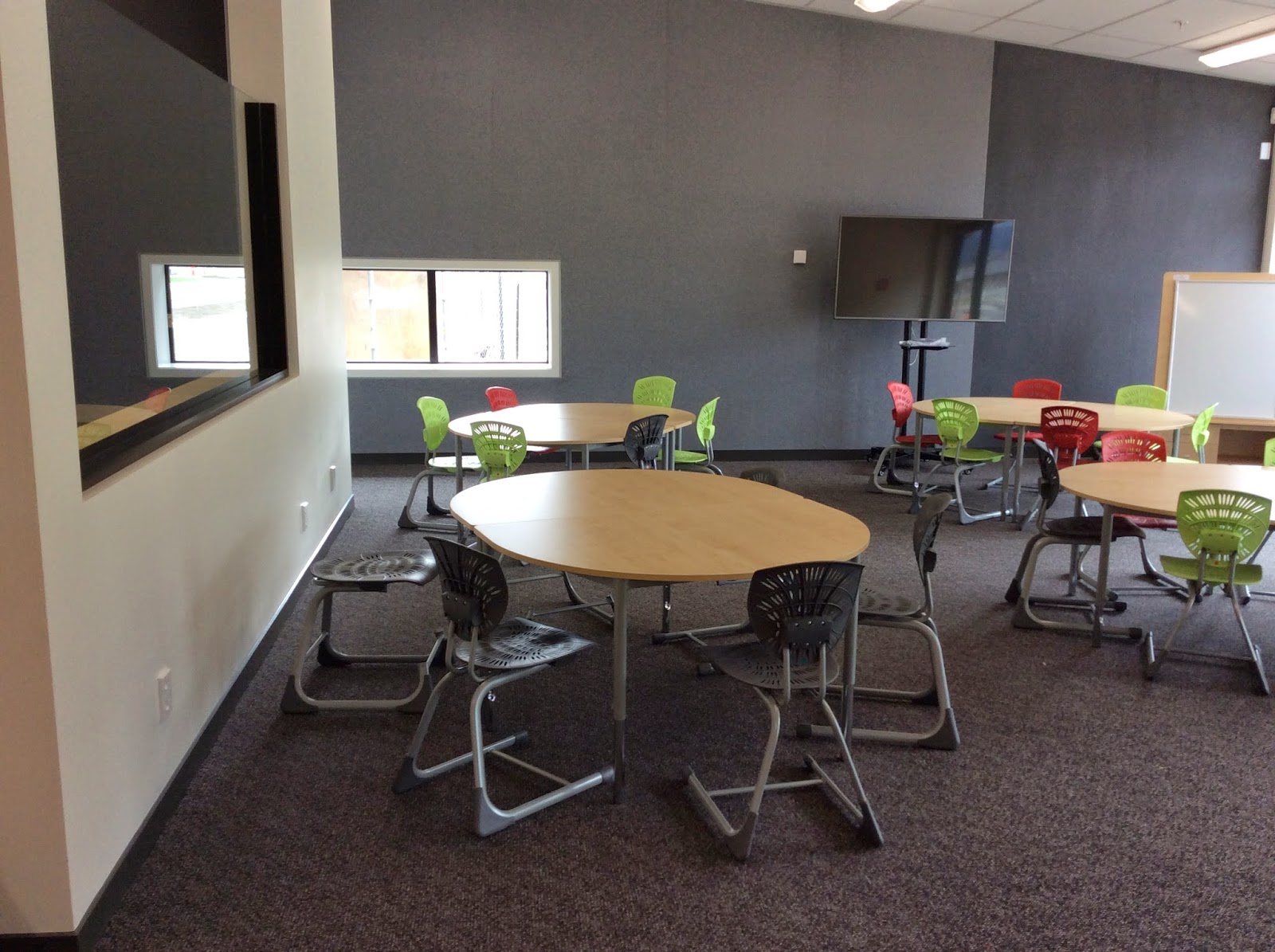
The indoor photos show the admin block first - of which still needs a lot more work. The photos of (just) one of the learning habitats really doesn't do it justice. It was so hard to capture the network of spaces within the habitat. There are two areas with tiered seating - one larger and facing a TV screen, the other facing a small stage. There is a wet area with a full kitchen and art bay. There is one quite large open space that will be able to be broken up with furniture if desired and then a smaller area, identified as a 'formal teaching space' which is broken off from the rest of the room by a wall with a window. There is a small break out room and another reasonably large media room which will be sound proofed. You can identify this space by its green screen wall - great for those filming projects!

The habitat is so well designed and leads itself to many functions and uses - I'm so looking forward to being in there!

The Learning Environment and a Discussion on Professionalism

Learning Spaces
We are so lucky to have such a wealth of knowledge and experience on our senior leadership team. I have been inspired by Claire's journey of learning spaces for a few years now after meeting her in the Educamp circles and then staying connected via Twitter. It is fantastic now to be working alongside her as we both fulfil a dream.

Today she, and Helen, imparted the theory and their knowledge about learning spaces. The number one message: everything we are doing is for the learner. This means that we have to think about the why - before the how and the what (practices are put in place). 

There are 7 spaces to make up a classroom: group, secret, data, watching, publishing, performing and participation spaces. We can certainly see all of these things in the plans of our habitats.

One of the most enlightening parts of the day for me was having the chance to Skype with the design and development architect, Wayne Stevens. It was so fantastic to hear him speak to his design and explain the theories behind different aspects. Credit for these notes goes to Claire, as I was too busy hanging on to every word.


  • The architecture can shape the behaviour and engage the students
  • The spaces will allow authentic, messy play, small and large group work, performance spaces
  • Children will be able to develop relationships with a range of adults
  • Building designed to suit the environment including schist
  • Interior has acoustic treatment to prevent reverberation: underlay, ceiling,
  • There is a closed off space that allows for acoustic isolation
  • Within each habitat, teachers need to plan for what daily activities are needed and where those activities will take place
  • Furniture: it’s not about moving furniture around on a daily basis. Moving furniture creates down time. The spaces need to be set up.
  • Education needs to be transformed and this will happen with personalisation and student agency.
  • Neuro science: the blue light makes the brain attentive. (South light)
  • Need to expel the carbon dioxide by opening windows even in winter
  • Blockers (typically parents) will show concern re noise
  • Groups sharing a space become white noise
  • Displays: teachers need to define the purpose of display and agreed practice
  • Montessori: meaningful displays that show the learning process
  • Internal glass creates transparency which promotes transparency of practice and openness of learning

It started to get real when we were given the floor plan along with the list of planned furniture. I think everyone in the room is just waiting now for that site visit so we can check to see if what's in our heads is for real!!!


Professionalism
I really love that this team, right from the top, live their speak. The latest big project was to develop our definition of professionalism. In two groups we had to come up with four 'elements' and list the details behind that. Then we had to write a statement 'Professionalism looks like.... because... because...' I really liked that we had to justify our over arching statement twice as it really made us consider the WHY! From here we then talked through and joined the two documents all together with the principal as a facilitator continually checking that we agreed. What an eye-opening and amazing process to go through. It took quite some time but we really had ownership of that document and will live by it because of that.